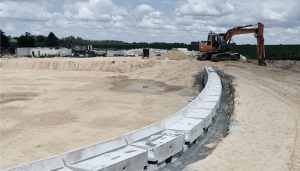
The beginnings of The Precast Forte Group launched over 25 years ago with the vision to create a form system that would produce large-scale, modular, decorative retaining wall blocks known as Recon Retaining Wall Systems. Forte has grown over time, launching and incorporating new precast concrete products such as LPB (Light Pole Base) and EV Blocks.
The Latest Innovations Around Precast Concrete
Over the years, precast concrete has increased in demand. The industry continues to grow in innovation, both with technology and application, in the cities you see around you today.
- 3D printing, or additive manufacturing, has grown over the past 30 years in precast concrete production. This technology allows for intricate and customized prototype design. 3D printing in precast concrete enables the fabrication of complex shapes that were previously difficult or expensive to produce using traditional methods.
- Self-Healing Concrete has provided a natural and automatic “healing” process when concrete develops cracks using capsules that release healing agents when activated by water or air. This type of concrete is being incorporated into precast concrete for structures that are subject to cracking.
- Smart sensors are making their way into precast concrete to monitor different aspects of the concrete’s performance, including temperature, humidity, stress, and cracking. Construction managers or maintenance teams can use these sensors to monitor the structure of a building in real time helping with early detection of potential issues.
- The use of alternative materials to improve the sustainability rating has grown using recycled aggregates and other products like fly ash or slag to reduce the carbon footprint of production.
- Modular Precast Concrete Systems, like Light Pole Base, Recon Walls, and EV Blocks, involve manufacturing the precast concrete components off-site in a controlled environment before transporting and installing the modules on-site. The modules are manufactured in standard sizes allowing for faster installs. Modular precast construction significantly reduces on-site construction time, lowers labor costs, and enhances quality control.
Where Can You Find More Use of Precast Concrete in Urban Development Today?
As cities continue to grow, precast concrete is increasingly being utilized for high-rise residential and commercial buildings and parking garages due to its durability, speed of installation, and the ability to accommodate limited spaces.
With more of an emphasis on sustainable building practices in the past decade, precast concrete is being embraced in green building projects. Due to its thermal mass properties precast concrete helps regulate building temperatures and reduce energy spend.
Precast concrete is increasingly being used in the construction of bridges, tunnels, and transit systems, since it allows for faster, more efficient construction especially in dense urban environments.
These innovations and trends highlight how the precast concrete industry is evolving in today’s world by incorporating new technologies and sustainable building materials.
At the Precast Forte Group, we are always evolving, too. We continue to monitor and adopt the smartest solutions in precast concrete for installers and manufacturers.